

Scan for mobile page
QR
Other equipment
Production of shoe soles
The world market continues to produce shoes made of various raw materials. Of course, the variety of products allows the customer to choose. Shoes entering our markets from abroad force the owners of this field in our country to search. Of course, the shoe manufacturing industry is developing in our country, but modernization of production technologies is required. In this way, it is possible to reduce the amount of imports.
Price
$35,700
A
Aziz Karimov
I reply within 12 minutes
Specifications
| Model | TG-LB-20x22 |
| Raw material | TPR/PVC/TPU |
| Screw diameter | 75 mm |
| Screw rotation speed | 0-160r/min |
| Length and diametric ratio | 20:01 |
| Number of stations | 20 |
| Maximum injection volume | 660 cm3 |
| Plasticization | 40 g/s |
| Injection pressure | 5 MPa |
| Disc pressure | 3 MPa |
| Mold frame size | 340x180x60mm |
| Total power | 35.5 sq |
| Shoe depth | 70mm |
| Shoe length | 210-260mm |
| Size | 6290x6150x1955mm |
| Weight | 12300 kg |
| Maximum pressure | 8 bars |
| Voltage | 220V/50Hz |
| Power | 3 sq |
| Size | 900*360*735mm |
| Weight | 68 kg |
Description
"AFEX-GROUP" is modern for our entrepreneurs in solving these problems
offers technologies. This equipment was purchased by our company
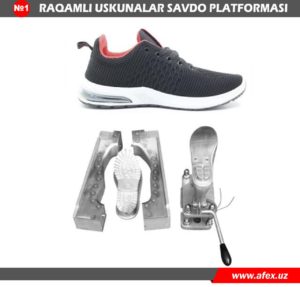
practical assistance is provided for clients. This equipment is used in the production of shoes,
It was not complicated and convenient for our new entrepreneurs
technological equipment. That is, leather, fabric, artificial leather and other types of equipment molds
The upper part of the shoe is combined with the injection of the sole part.
This equipment differs significantly from other types of equipment in terms of quality and quantity speed.
 The equipment is able to work with the following raw materials:
PVC, TPR, TPU
Let's talk briefly about shoe soles made from these raw materials.
The shoe sole is one of the most important parts of the shoe in production
the raw materials used should be as resistant to environmental influences as possible.
Polyvinyl chloride (PVC) - shoe soles for spring and autumn shoes
use is appropriate.
The equipment is able to work with the following raw materials:
PVC, TPR, TPU
Let's talk briefly about shoe soles made from these raw materials.
The shoe sole is one of the most important parts of the shoe in production
the raw materials used should be as resistant to environmental influences as possible.
Polyvinyl chloride (PVC) - shoe soles for spring and autumn shoes
use is appropriate.
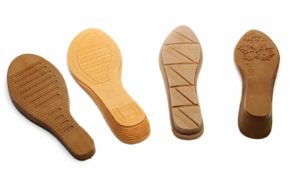 PVC shoe sole - durable for a long time, resistant to aggressive environment and durable
easy to release. They are often used in household and children's shoes, and previously they were safety
Widely used for shoes, because when mixed with rubber, PVC oil and
will have properties such as resistance to gasoline. PVC- simple only for autumn or spring
used in the production of shoes, because this material has a large mass and is resistant to cold
low durability, does not withstand temperatures below -20 C. Also, PVC base
leather doesn't adhere well to the upper, so quality leather shoes with PVC soles
difficult and expensive to produce.
Thermoplastic rubber (TPR) - for shoe soles, shoes and winter boots
is used.
PVC shoe sole - durable for a long time, resistant to aggressive environment and durable
easy to release. They are often used in household and children's shoes, and previously they were safety
Widely used for shoes, because when mixed with rubber, PVC oil and
will have properties such as resistance to gasoline. PVC- simple only for autumn or spring
used in the production of shoes, because this material has a large mass and is resistant to cold
low durability, does not withstand temperatures below -20 C. Also, PVC base
leather doesn't adhere well to the upper, so quality leather shoes with PVC soles
difficult and expensive to produce.
Thermoplastic rubber (TPR) - for shoe soles, shoes and winter boots
is used.
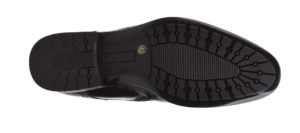 Thermoplastic rubber is shoe rubber made from synthetic rubber, which is natural
stronger than rubber, but no less elastic. Modern technologies are his
it is possible to use various additives to increase flexibility
Thermoplastic rubber has a low density and, accordingly, another
has less weight than materials. It has no holes at the bottom, so
for moisture does not pass. Of course, in wet and cold weather, the thermoplastic rubber sole is great
will be smooth.
Thermopolyurethane (TPU)-Used for winter shoes.
Thermoplastic rubber is shoe rubber made from synthetic rubber, which is natural
stronger than rubber, but no less elastic. Modern technologies are his
it is possible to use various additives to increase flexibility
Thermoplastic rubber has a low density and, accordingly, another
has less weight than materials. It has no holes at the bottom, so
for moisture does not pass. Of course, in wet and cold weather, the thermoplastic rubber sole is great
will be smooth.
Thermopolyurethane (TPU)-Used for winter shoes.
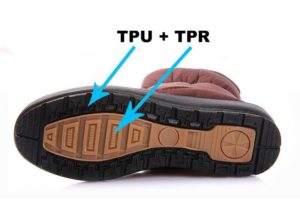 Thermopolyurethane- has a high enough density, so it is easy to pull
can be used in the production of a deep base that provides. Also TPU
advantages are high durability and resistance to deformation. Thermopolyurethane
high density is a sign of the weight of the base, its elasticity and thermal insulation
TPU is often combined with polyurethane to improve properties and thus
the weight of the base decreases, its thermal insulation and elasticity increase. This method is two
It's called composite molding, and it's easy to recognize: it's a technology
The base is made of two layers, the upper layer is made of polyurethane (PU),
and the lower part is made of thermopolyurethane.
Necessary infrastructures for starting the activity;
Required area: Should not be less than 80 m².
Electric power: 40 KW/380 V.
Number of employees: 6-10 people.
All production industries require water as the main source.
Thermopolyurethane- has a high enough density, so it is easy to pull
can be used in the production of a deep base that provides. Also TPU
advantages are high durability and resistance to deformation. Thermopolyurethane
high density is a sign of the weight of the base, its elasticity and thermal insulation
TPU is often combined with polyurethane to improve properties and thus
the weight of the base decreases, its thermal insulation and elasticity increase. This method is two
It's called composite molding, and it's easy to recognize: it's a technology
The base is made of two layers, the upper layer is made of polyurethane (PU),
and the lower part is made of thermopolyurethane.
Necessary infrastructures for starting the activity;
Required area: Should not be less than 80 m².
Electric power: 40 KW/380 V.
Number of employees: 6-10 people.
All production industries require water as the main source.
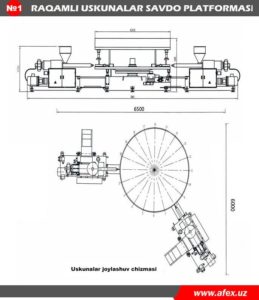 In this drawing you can see the equipment with 2 color (extruder), 20 stations
possible, the required space for the equipment is 6.5 x 6 meters. If you have 1 color
(extruder) equipment if you want to buy a machine with 20 stations
6.5 x 4 meters is required for planting.
In this drawing you can see the equipment with 2 color (extruder), 20 stations
possible, the required space for the equipment is 6.5 x 6 meters. If you have 1 color
(extruder) equipment if you want to buy a machine with 20 stations
6.5 x 4 meters is required for planting.
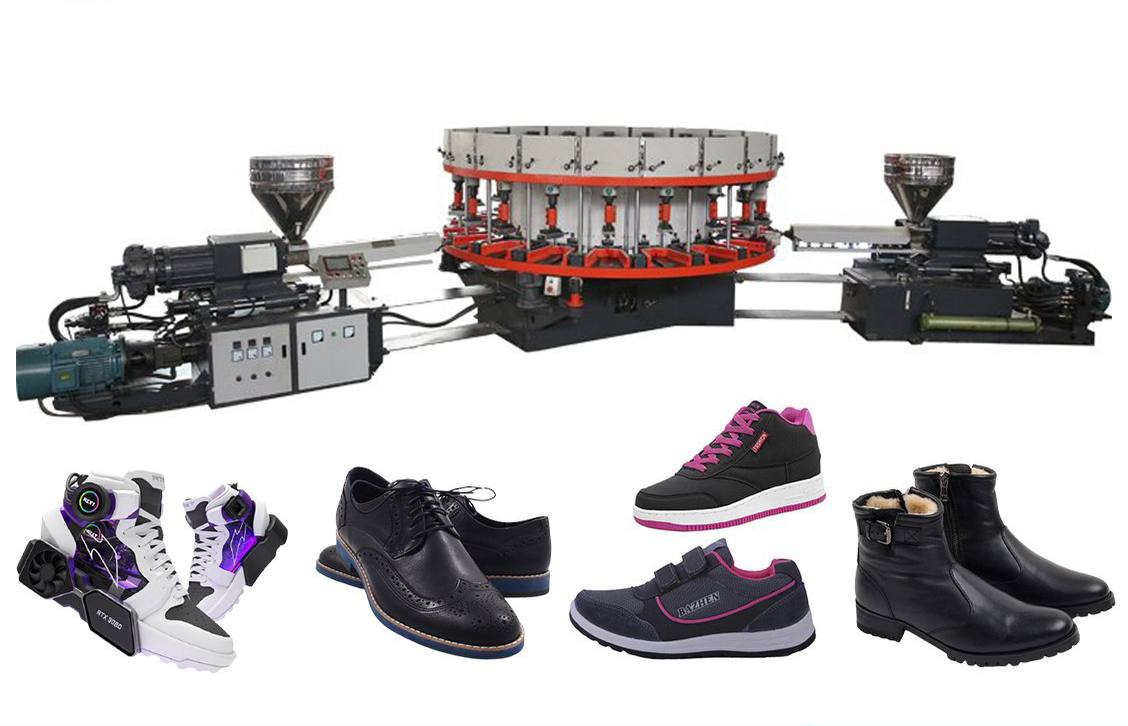
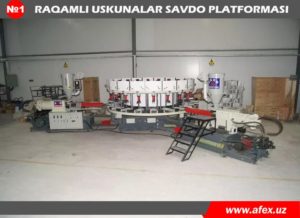 General classification of footwear production equipment:
The total equipment includes two extruders with a diameter of 75 mm and
one- 20 has a special rotary motion machine adapted to molding. Special circle
there are enough opportunities to carry out work activities at the table.
Fully hydraulic pressure and cycle controlled on PLC control panel.
* Automatically by preselecting the plasticizing temperature
can be controlled.
* Equipment 20 measuring points injection volume according to the requirements of each mold
can be chosen.
* A convenient storage space is provided for easy operation in the empty mold.
* There is a parallel mold closing mechanism.
* The equipment is double injection molding system and mold closing order to choose
equipped with spasms.
* Custom rotary table motion can be configured.
General classification of footwear production equipment:
The total equipment includes two extruders with a diameter of 75 mm and
one- 20 has a special rotary motion machine adapted to molding. Special circle
there are enough opportunities to carry out work activities at the table.
Fully hydraulic pressure and cycle controlled on PLC control panel.
* Automatically by preselecting the plasticizing temperature
can be controlled.
* Equipment 20 measuring points injection volume according to the requirements of each mold
can be chosen.
* A convenient storage space is provided for easy operation in the empty mold.
* There is a parallel mold closing mechanism.
* The equipment is double injection molding system and mold closing order to choose
equipped with spasms.
* Custom rotary table motion can be configured.
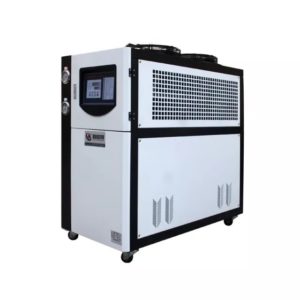 Water cooling device using Chiller-Havo.
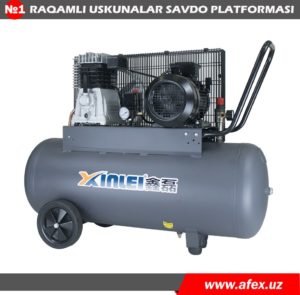 The air compressor-Equipment works on a special rotary table, i.e
is an auxiliary device for molding (pneumatic cylinder).
The air compressor-Equipment works on a special rotary table, i.e
is an auxiliary device for molding (pneumatic cylinder).
Equipment prices: SINGLE COLOR
12 station 35700$ 16 station 40800$ 20 station 45900$TWO COLORS
20 stations $90,600 *These prices include molds! Additional molds $2000-$3100/Pair (depends on mold types)
The equipment is able to work with the following raw materials:
PVC, TPR, TPU
Let's talk briefly about shoe soles made from these raw materials.
The shoe sole is one of the most important parts of the shoe in production
the raw materials used should be as resistant to environmental influences as possible.
Polyvinyl chloride (PVC) - shoe soles for spring and autumn shoes
use is appropriate.
PVC shoe sole - durable for a long time, resistant to aggressive environment and durable
easy to release. They are often used in household and children's shoes, and previously they were safety
Widely used for shoes, because when mixed with rubber, PVC oil and
will have properties such as resistance to gasoline. PVC- simple only for autumn or spring
used in the production of shoes, because this material has a large mass and is resistant to cold
low durability, does not withstand temperatures below -20 C. Also, PVC base
leather doesn't adhere well to the upper, so quality leather shoes with PVC soles
difficult and expensive to produce.
Thermoplastic rubber (TPR) - for shoe soles, shoes and winter boots
is used.
Thermoplastic rubber is shoe rubber made from synthetic rubber, which is natural
stronger than rubber, but no less elastic. Modern technologies are his
it is possible to use various additives to increase flexibility
Thermoplastic rubber has a low density and, accordingly, another
has less weight than materials. It has no holes at the bottom, so
for moisture does not pass. Of course, in wet and cold weather, the thermoplastic rubber sole is great
will be smooth.
Thermopolyurethane (TPU)-Used for winter shoes.
Thermopolyurethane- has a high enough density, so it is easy to pull
can be used in the production of a deep base that provides. Also TPU
advantages are high durability and resistance to deformation. Thermopolyurethane
high density is a sign of the weight of the base, its elasticity and thermal insulation
TPU is often combined with polyurethane to improve properties and thus
the weight of the base decreases, its thermal insulation and elasticity increase. This method is two
It's called composite molding, and it's easy to recognize: it's a technology
The base is made of two layers, the upper layer is made of polyurethane (PU),
and the lower part is made of thermopolyurethane.
Necessary infrastructures for starting the activity;
Required area: Should not be less than 80 m².
Electric power: 40 KW/380 V.
Number of employees: 6-10 people.
All production industries require water as the main source.
In this drawing you can see the equipment with 2 color (extruder), 20 stations
possible, the required space for the equipment is 6.5 x 6 meters. If you have 1 color
(extruder) equipment if you want to buy a machine with 20 stations
6.5 x 4 meters is required for planting.
General classification of footwear production equipment:
The total equipment includes two extruders with a diameter of 75 mm and
one- 20 has a special rotary motion machine adapted to molding. Special circle
there are enough opportunities to carry out work activities at the table.
Fully hydraulic pressure and cycle controlled on PLC control panel.
* Automatically by preselecting the plasticizing temperature
can be controlled.
* Equipment 20 measuring points injection volume according to the requirements of each mold
can be chosen.
* A convenient storage space is provided for easy operation in the empty mold.
* There is a parallel mold closing mechanism.
* The equipment is double injection molding system and mold closing order to choose
equipped with spasms.
* Custom rotary table motion can be configured.
Water cooling device using Chiller-Havo.
The air compressor-Equipment works on a special rotary table, i.e
is an auxiliary device for molding (pneumatic cylinder).


